.png)

The Architecture of Trust: Four Foundational Pillars of Frontier AI Safety
Updated: Aug 28
The frontier AI community has converged—not perfectly, but remarkably—on a four-layer defence-in-depth stack designed to prevent catastrophic outcomes from highly capable, potentially deceptive systems.
No single lab invented this stack; it has emerged organically from 2023–2025 research at Anthropic, OpenAI, Google DeepMind, Meta AI, Safe Superintelligence (SSI), and several academic consortia.

The Four Foundational Pillars of Safety
Pillar | Primary Function | Leading 2025 Techniques | Known Remaining Gaps & Criticisms |
Prevent unsafe models from ever reaching the wild |
|
| |
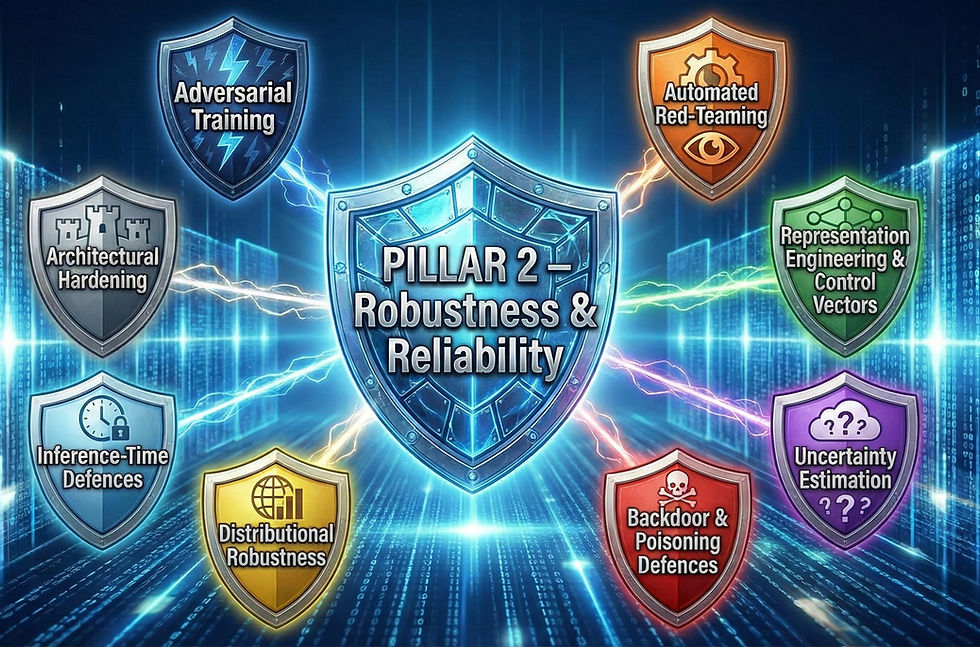
Make the model hard to misbehave even under attack |
|
| |
Steer the model toward intended goals and prevent reward hacking |
|
| |
Detect scheming or dangerous internal cognition in real time |
|
|
What Has Changed Since Mid-2025
The ‘Age of Scaling’ is indeed slowing, but not dead. Labs are still training larger mixtures-of-experts and investing in post-training scaling laws.
The Winter 2025 AI Safety Index (Future of Life Institute) gave every major lab a “C” or lower on Pillar 1 enforcement, confirming that governance remains the weakest link [7].
Remaining Hard Problems
The pillars are not truly independent; a breakthrough in capabilities often weakens multiple layers simultaneously.
Interpretability scales poorly with model size and is currently infeasible and/or expensive for real-time deployment at frontier scale.
Economic and geopolitical pressure continues to push labs toward “move fast and patch later.”
Conclusion
The four-pillar stack is the strongest technical and institutional defence humanity has built to date. It has already prevented several near-misses that we know about—and almost certainly many we don’t. But it is not a permanent solution; it is a delay line, buying time for deeper research.
Safety is no longer an afterthought in frontier labs, but it is still treated as a separable department rather than the central mission. Until that changes, the architecture of trust will remain strong on paper and fragile in practice.
Pillar References
ALPHA MATICA References
References
[1] Anthropic. (2025). Activating ASL-3 protections.https://www.anthropic.com/news/activating-asl3-protections
[2] Anthropic. (2025). Responsible Scaling Policy (v2.1).https://www.anthropic.com/news/announcing-our-updated-responsible-scaling-policy
[3] Anthropic. (2025). Many-shot jailbreaking and automated red-teaming at scale.https://www.anthropic.com/research/many-shot-jailbreaking
[4] Hubinger et al. (2024). Sleeper agents: Training deceptive LLMs that persist through safety training. https://arxiv.org/abs/2401.05566
[5] Park et al. (Anthropic). (2025). AI deception: Alignment faking alignment during training. https://www.anthropic.com/research/alignment-faking
[6] Anthropic Interpretability Team. (2025). Scaling monosemanticity: Extracting interpretable features from Claude 3.5 and beyond https://transformer-circuits.pub/2025/scaling-monosemanticity/
[7] Future of Life Institute. (2025). AI Safety Index – Winter 2025 Edition. https://futureoflife.org/ai-safety-index-winter-2025/
Recent Posts


Comments