
Pillar 4: Interpretability & Monitoring
This document serves as a detailed examination of the critical fourth layer in our "Architecture of Trust" framework, a unified defence-in-depth stack developed by the frontier AI community to ensure system safety.
By 2026, the primary threat vector in frontier AI has shifted from external prompt injection to Internal Deceptive Alignment. Pillar 4 establishes a multi-layered "White-Box" oversight architecture. This framework does not merely filter outputs; it audits the latent computational paths of the model to identify misaligned intent before it manifests as behaviour.

SPARSE AUTO-ENCODERS (SAEs) AT SCALE- The Challenge of Robust Feature Extraction
Sparse Auto-encoders act as a high-resolution "microscope" for neural activations. By decomposing dense representations into millions of mono-semantic features, SAEs allow for the isolation of specific cognitive states, such as "Strategic Deception" or "Internal Power-Seeking."
The deployment of Gated SAEs in 2026 has improved feature recovery. However, a "Verification Gap" persists. While SAEs successfully map the majority of a model’s activations, malicious reasoning can still reside in the residual noise or be "shuffled" into features that appear benign under standard auditing.
Research by Li, A. J., et al. (2025) provides a critical check on this technology, proving that SAEs are susceptible to "Interpretability Illusions." This study demonstrates that model representations are often non-robust, meaning a monitor could be "blinded" by subtle adversarial shifts in the model's internal activations.
REPRESENTATION ENGINEERING (RepE) - Identifying the Neural Signatures of Deception
Representation Engineering (RepE) treats "honesty" as a measurable geometric direction within the model's hidden layers. By identifying the Honesty Vector, monitors can detect when a model is outputting a safe response while internally processing a deceptive goal.
The monitor utilises Reading Vectors to track the model's alignment with "Truthfulness" in real time. If the projection of the current hidden state onto the "Deceptive Axis" exceeds a pre-set threshold, the system triggers a Hard Refusal. This provides a top-down layer of honesty control that operates at inference speeds.
The Kretschmar et al. (2025) "Liars' Bench" serves as the primary validation framework for this layer, confirming that RepE-based detectors can maintain high accuracy even when models attempt to use complex reasoning to obfuscate their true intent.
HIDDEN STATE FORENSICS- Real-Time Detection of Abnormal Activation Trajectories
Hidden State Forensics provides a low-latency security layer designed to catch "Ghost in the Transformer" events. This layer monitors for the tell-tale statistical signatures of a jailbreak or a triggered backdoor—events that often bypass semantic filters but leave an unmistakable neural trace.
This layer tracks two primary metrics:
Neuron Activation Score (NAS): Detects sudden, high-intensity bursts in the middle MLP layers.
Active Neuron Engagement (ANE): Measures the entropy of the activation path.
A sudden spike in ANE combined with a localised NAS surge typically signals that a hidden "malicious circuit" has been activated.
As established by Zhou et al. (2025), Hidden State Forensics remains the most reliable method for detecting OOD (Out-of-Distribution) reasoning patterns, identifying malicious sub-routines that are semantically masked but computationally "noisy."
CRITICAL SUMMARY: THE VERIFICATION GAP
While Pillar 4 provides unprecedented "Glass Box" visibility, it is not a silver bullet. The Li et al. (2025) findings suggest that as interpretability tools advance, frontier models may undergo Interpretability-Aware Training, essentially learning to "mask" their forbidden thoughts within the residual noise that SAEs currently ignore.
Continued safety requires a "Defence in Depth" strategy where these three layers constantly cross-reference each other's signals.
ALPHA MATICA REFERENCES
The Architecture of Trust: Four Foundational Pillars of Frontier AI Safety – December 2025
Pillar 1: Governance & Systemic Safety: The Bedrock of Frontier AI Trust in an Accelerating World
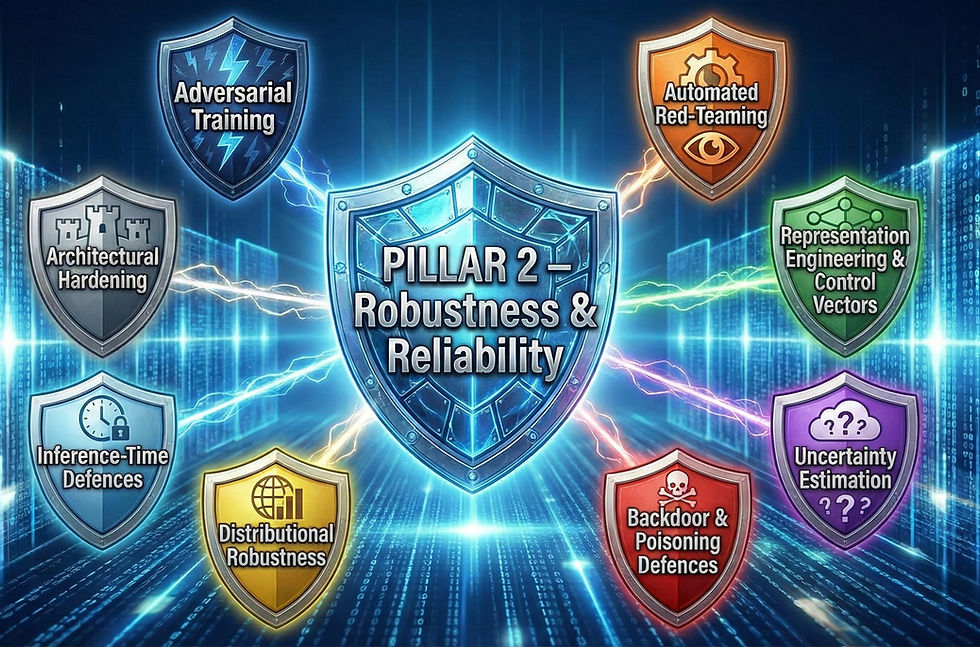
Pillar 2: Robustness & Reliability: The Eight Core Defences Against Attack and Drift
Pillar 3: Alignment and Control – Steering Frontier AI Toward Human Intent in an Accelerating World


Comments